Stern metal type from the Rimmer Type Foundry

sternbooklet2

Stern booklet (image courtesy of P22 Type Foundry)

Following the release last July of the typeface Stern, designed by Jim Rimmer, a great deal of willpower had to be summonsed to prevent me from placing an order for the metal version of the typeface. Unfairly placed just above an image of a shimmering newly cast fount of Stern, the ‘Order’ button on The Rimmer Type Foundry microsite seems as irresistable now as when I first hovered over it!

Apparently, the simultaneous release of Stern in both digital and cast metal versions was a first and it is encouraging that the first ‘Subscription Casting’ sold out quickly and there is now a wait of at least two months of new orders. Perhaps I should give in to temptation and click on that little, harmless, ‘Order’ button… It would be a pity to not be able to add Stern to my collection of letterpress type!

The metal version of the typeface is cast to order by Jim Rimmer, in foundry metal. It is cast only in 16pt on an 18pt body and further information can be obtained from The Rimmer Type Foundry along with details of the digital version, Stern Pro. It is heartening to see such herioc typecasting endeavours paying off and the making of the typeface is also to be made into a documentary, due for release this Spring.

Stern cast in 16pt on 18pt body (image courtesy of P22 Type Foundry)

Stern cast in 16pt on 18pt body (image courtesy of P22 Type Foundry)

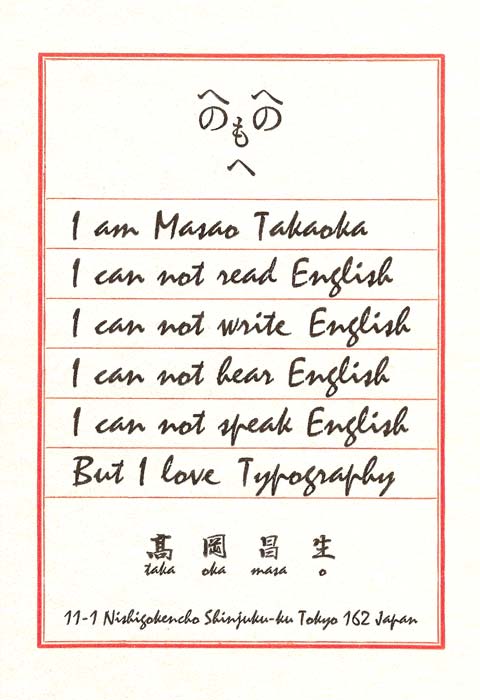
…But I love Typography!

But I love Typography

This letterpress printed postcard was sent to me, some years ago, by Masao Takaoka; proprietor of The Kazui Press in Tokyo. It is one of my favourite pieces of letterpress ephemera, that I have in my collection. I received it along with an enormous bundle of beautifully printed samples from The Kazui Press and a copy of their impressive type specimen book.

Make-ready and overlaying on letterpress cylinder presses

I have been extremely fortunate to receive a day’s tuition from Phil Abel at Hand & Eye Letterpress, in the fine art of ‘make-ready’ and ‘overlaying’ on the letterpress cylinder press. After mentioning to Phil that I hope to achieve high-quality work on my Wharfedale press, once it is restored to working order, he kindly invited me along to Hand & Eye for some guidance! For the past two years Phil’s expert skills in pressmanship have been employed in printing The Letterpress Shakespeare for The Folio Society, on his Heidelberg cylinder press.

The technique of ‘overlaying’ involves increasing or decreasing the thickness of the packing that wraps around [dresses] the cylinder to achieve a more even impression over the printed page. Whilst, to the layman, this sounds quite a straightforward process, it requires great skill and patience.

The top sheet of the cylinder dressing is usually of stout manilla and the remainder of various grades of printing paper, although rubber litho blankets and acetate are often included in modern letterpress printing offices.

The first stage involves taking a first proof of the forme, once the level of impression and positioning has been set. This sheet should be examined carefully and areas where there is too much, or too little impression, should be marked. Then a sheet of newsprint, or similar paper of around 50gsm in weight, should be fixed into the grippers on the cylinder and a bodkin is used to spike through the newsprint about two inches from each vertical edge of the sheet.

Phil Abel examining and marking the back of the sheet, for an areas where impression needs to be reduced.

Phil Abel examining and marking the back of the sheet, for an areas where impression needs to be reduced.

Spiking the dressing with a bodkin, for registration.

Spiking the dressing with a bodkin, for registration.

A print is then made onto this sheet of newsprint and it can be removed from the press and taken to a cutting surface for removing portions of the paper where too much impression is evident. At the same time, two V’s are cut from each edge of the paper, using the holes made by the bodkin as a starting point. A strip also needs to be cut from the gripper edge of the newsprint so that it will clear the grippers when placed in the dressing on the cylinder.

Cutting V's from the sheet, starting at the holes made by the bodkin.

Cutting V's from the sheet, starting at the holes made by the bodkin.

Once cutting is complete, this sheet will need to be incorporated into the dressing in place of an existing sheet of the same thickness. The manilla top sheet and acetate (if used) are then released from the gripper bar on the cylinder and the prepared overlay is then glued to a lower sheet of packing with a few spots of glue, clear of any printing areas. The top sheets are then replaced and tightened around the cylinder before another proof is taken. It is likely that more areas will still show uneven pressure and these should be marked as before.

Replacing the cut sheet on the cylinder.

Replacing the cut sheet on the cylinder.

Where areas of the text appear too light, pieces of newsprint, bible or tissue paper should be cut out and glued to the surface of the first overlay (that serves as a guide to positioning) on the cylinder. If too much impression is evident on parts of the printed page, the corresponding areas should be carefully cut from the overlay so that the thickness of the cylinder dressing is reduced in those areas.

Marking areas of the text where the impression is too light.

Marking areas of the text where the impression is too light.

Adding extra thickness to the packing to increase the impression in those areas.

Adding extra thickness to the packing to increase the impression in those areas.

Adding bible paper to areas of text that still appear slightly too light.

Adding bible paper to areas of text that still appear slightly too light.

The press cylinder and marked up proof sheet.

The press cylinder and marked up proof sheet.

It can take many hours to complete the make-ready and overlaying on a cylinder press although the quality of work will be greatly enhanced if sufficient care and attention is given to dressing the cylinder correctly.

I am extremely grateful to Phil Abel for his kind help and guidance and I look forward to putting this new found knowledge into practice when my Wharfedale is back in working order.

Marking areas where packing needs to be removed, to reduce impression.

Marking areas where packing needs to be removed, to reduce impression.
The Occasional Print Club

The Occasional Print Club was formed in November 2008, in the corner of a thronging London ale house behind Fleet Street, by myself and three other typographers; Jonathan Kielty, Pat Randle and Ross Shaw. We were full of energy and enthusiasm, having spent that day at the excellent Letterpress: A Celebration conference at the St Bride Library.

Left to right: Pat Randle, Justin Knopp, Ross Shaw and Jonathan Kielty

Left to right: Pat Randle, Justin Knopp, Ross Shaw and Jonathan Kielty

The inaugural meeting of the OPC took place in late January 2009 around the bed of a Western proofing press at The Whittington Press by the kind invitation of the proprietor, John Randle. A commemorative letterpress poster was designed, typeset and printed during the two days we spent at Whittington. Further meetings are planned to be held in our respective letterpress workshops, across this green and pleasant land, over coming months and years.

Pat Randle adjusting the letterpress forme, on the bed of a Western proofing press.

Pat Randle adjusting the letterpress forme, on the bed of a Western proofing press.

A hand-inked wooden numeral.

A hand-inked wooden numeral.

The impression cylinder passes over the printing forme.

The impression cylinder passes over the printing forme.

Our completed letterpress poster.

Our completed letterpress poster.

More photographs can be viewed via our Flickr Photostream at www.flickr.com/photos/theoccasionalprintclub.

Moving a Victorian cylinder printing press

Whilst work continues to get my 1888 Wharfedale stop cylinder press restored and back into working order, I have put together this whimsical movie of the day we relocated it to our workshop. I was grateful for the expert assistance of C.J. Overy Transport and the generous help of a willing band of friends and letterpress enthusiasts!

More information about this fine printing press and the ongoing project to restore it can be found here.

Out of sorts?

Apologies for the recent hiatus of posting to this blog but most of my energy has been expended out in the workshop, of late. Our range of letterpress Christmas cards are proving to be very popular and a reprint of some designs is underway. We are also engaged in some bespoke letterpress projects and the Typoretum is a veritable hive of activity!

I recently needed to source some ‘at’ symbols for one of these bespoke projects and I am greatly indebted to my good friend and fellow letterpress printer, Julius Stafford-Baker of the Happy Dragons’ Press, for sending me a selection in 8pt, 10pt and 12pt. I would like add that Julius has recently opened a new and rather useful department – especially for letterpress printers – and it is called The Composing Room Stores.

Julius has often regaled me with tales of his experiences in around printing firms in the City of London, from the late 1950s onwards, and how a “boy on a bike” would be sent out for ‘sorts’ if a compositor ran out of type for a job. These firms that loaned sorts have long gone but letterpress printers, like myself, still occasionally run out of sorts or require special characters. Julius hopes that The Composing Room Stores will be able to help when situations like that arise.

In addition to loaning sorts, The Composing Room Stores can also supply quoins, furniture, leads, spacing, make-ready material in addition to technical assistance. Julius’s Poetry Book Shop is also well worth a look and his beautiful New Garland Series of poetry books are all printed from hand set letterpress type and the original artist’s wood blocks and linocuts.

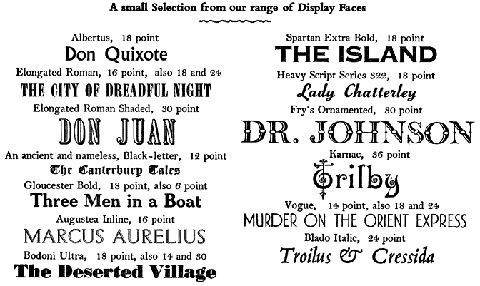
A small selection of the typefaces held at The Composing Room Stores, of which sorts are available.

A small selection of the typefaces held at The Composing Room Stores, of which sorts are available.

A chance encounter with the wood engraving of Reynolds Stone

Yesterday we had our chimney swept and our friendly sweep, knowing that I am an ‘old-time printer’, brought along a box of assorted printing blocks for me to look at.

Along with the ubiquitous halftones, military shields and farm animals, one block caught my eye as I recognised it to be an original wood engraving. On closer inspection it was obviously engraved by a highly skilled individual and it was then that I noticed a signature on the side that identified it as the work of the noted 20th century wood engraver, Reynolds Stone (1900-1979).

The engraving bears a shield containing the heads of two dogs and a pegasus, above the motto ‘Arte et Scientia Ditamur’. This translates as ‘We are enriched by art and science’ and was the motto of the Mid-Essex Technical College & School of Art (now part of the Anglia Ruskin University). The fine detail of the lettering demonstrates Reynold Stone’s particular skill in letter carving and the leg of the terminal ‘R’ is wonderfully elegant.

Taped to the underside of the block I found a small, but stern, warning to printers, stating that the block is not to be printed and is to be used for the making of master printing blocks (electroplates) only. Needless to say, I ignored this note and printed, with great care, a small number of prints for my friends in the Letterpress Exchange Group.

The wood engraving, by Reynolds Stone, measuring 14 by 12 ems.

The wood engraving, by Reynolds Stone, measuring 14 by 12 ems.

‘We are enriched by art and science’.

‘We are enriched by art and science’.

A stern warning to printers!

A stern warning to printers!

Letterpress Christmas card range 2008

The gas lamps in the Typoretum have been burning late into the night, over recent weeks, but we are now delighted to introduce the fruits of our labour: a suitably festive selection of letterpress cards.

All of these cards are now available for purchase via our website at www.typoretum.co.uk/christmas.html and a brief rationale for each design can be read here.

Design No. 1:
‘NOEL’ Woodletter Christmas card

'Noel' Woodletter Christmas card

'Noel' Woodletter Christmas card forme and detail

Design No. 2:
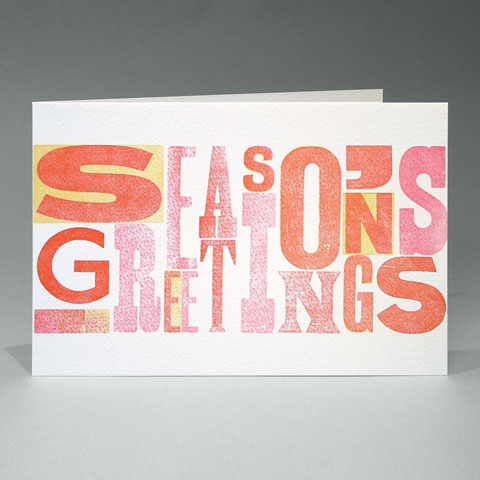
Antique Woodletter Season’s Greetings card

Antique Woodletter Season’s Greetings card

Antique Woodletter Season’s Greetings card forme and detail

Design No. 3:
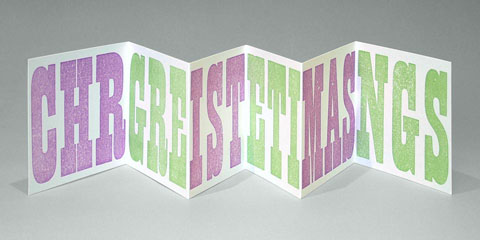
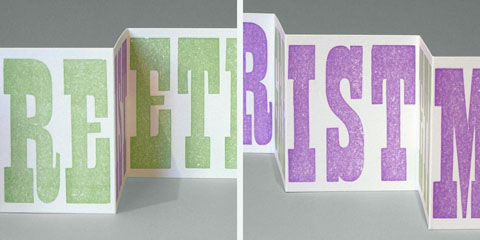
‘Christmas Greetings’ Woodletter Concertina card

‘Christmas Greetings’ Woodletter Concertina card

‘Christmas Greetings’ Woodletter Concertina card detail

Design No. 4 (colour option No. 1):
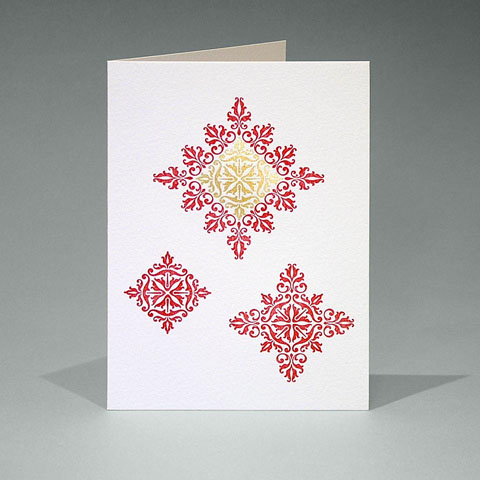
Floral ornament snowflake card in red and gold

Floral ornament snowflake card in red and gold

Floral ornament snowflake card in red and gold detail

Design No. 4 (colour option No. 2):
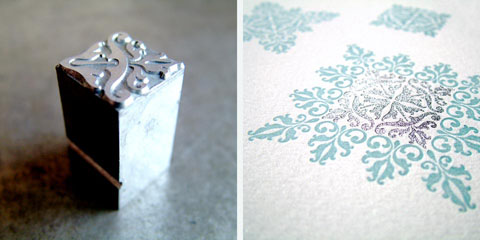
Floral ornament snowflake card in blue and silver

Floral ornament snowflake card in blue and silver

Floral ornament snowflake card in blue and silver detail and fleuron

Our letterpress cards are lovingly hand typeset and printed onto the finest quality 100% cotton 300gsm Somerset Textured printmaking paper. All of our cards are supplied with a high quality soft white envelope and the inside of each card has been left blank for your own message.

We also offer a personalisation service for all of our letterpress Christmas cards and we are pleased to provide quotations on request. For more information about personalisation of our letterpress cards, please contact us.

New Stockist – St Jude’s Gallery, Norfolk

We are pleased to announce that our letterpress greeting cards are now stocked at St Jude’s Gallery in Itteringham, Norfolk.

St Jude’s Gallery, Itteringham, Norfolk.

St Jude’s Gallery, Itteringham, Norfolk.

St Jude’s specialises in British art, craft, design and printmaking – together with paintings, modern and vintage furniture, ceramics and glass, books and cards, and some jewellery.

Based in the North Norfolk village of Itteringham, their gallery showcases the St. Jude’s range of fabrics and stationery, together with a selection of limited edition prints by the artists they collaborate with including Angie Lewin, Mark Hearld, Jonny Hannah, Chris Brown and Jonathan Gibbs.

2008 Christmas Card Designs – Preview

Well, the festive season is drawing nearer and today saw the first snowfalls of the coming winter. The Typoretum has been a hive of activity over recent weeks in order to create a pleasing selection of festive greeting card designs.

All of these cards will be available for viewing and purchase via our website at www.typoretum.co.uk from the 5th November. Remember, Remember!

Design No. 1
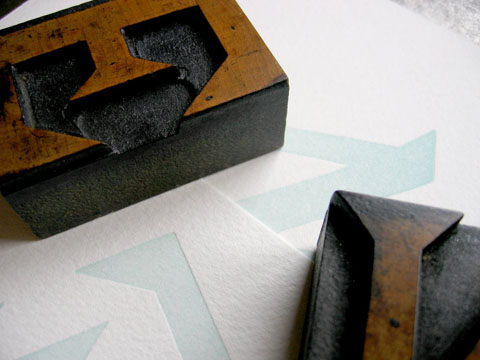
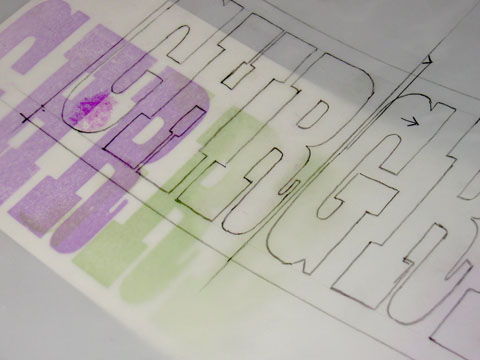
The triangular serifs of this unusual woodletter fount (below) provided me with the inspiration for my first design. By overprinting the serifs in a particular arrangement – and after quite a lot of working out – a festive symbol was created.

Christmas Card design No.1

Design No. 2
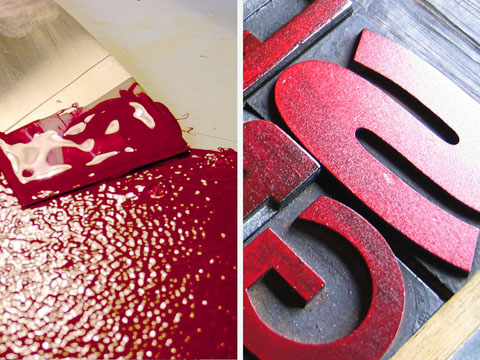
For my second design, I wanted to create a vibrant ensemble of as many woodletter founts as I could utilise. Since the age and condition of these wooden letters varies incredibly, the result is an energetic card with plenty of texture and character. I have chosen two rich colours and the dominant colour is a seasonal berry red that produces a rich third colour when overprinted onto the first.

Christmas Card design No.2

Design No. 3
I have a great fondness for concertina cards, as they enable me to utilise some of my larger woodletter founts for our greeting cards whilst observing the constraints of envelope sizes and postage rates. They also add a three-dimensional quality to the card and this design makes full use of that. The two words in the festive message appear and disappear when the card is viewed from different angles. When viewed from the front, the message appears as a jumble of letters!

Christmas Card design No.3

Design No. 4
I am still working on this design and it will feature a suitably festive arrangement of printer’s flowers, some of which I am planning to apply a little gold dust. I’m pleased that Christmas offers me the opportunity to get the metallic dust, cotton wool and sable brush out again as the process adds an elegant iridescent quality. The downside is that it is very time-consuming and quite messy!