The Columbian is by far the most lavishly decorated of all iron handpresses, although it must be noted that many of the embellishments function perfectly well as the working parts of the Press. The English writer T. C. Hansard once commented (shortly after the first Columbian Presses appeared in London) that: “If the merits of a machine were to be appreciated wholly by its ornamental appearance, certainly no other press could enter into competition with the Columbian”.
Invented in 1813 by the American George Clymer, the Columbian Press was one of the first iron printing presses and had a notable advantage over other iron handpresses, of that period. Clymer’s innovative and powerful combination of levers greatly increased the pressure that could be applied to the printing forme, without causing undue physical strain to the pressman.
The following description of the ornamentations on the Columbian Press is written by V. C. N. Blight CBE and taken from his publication entitled ‘The Columbian Press’, first published in 1962.
“At the time Clymer was perfecting his invention the United States was an infant nation and the very name Columbian was possibly a patriotic gesture. Even more so was the American eagle which perches defiantly with outstretched wings and open beak on the main counterbalance lever. The eagle is no mere ornament. It is the counterbalance weight, adjustable by sliding along the main counterbalance lever. For practical purposes a lump of lead would have sufficed, but to George Clymer’s way of thinking the job could be done properly only by the American eagle.
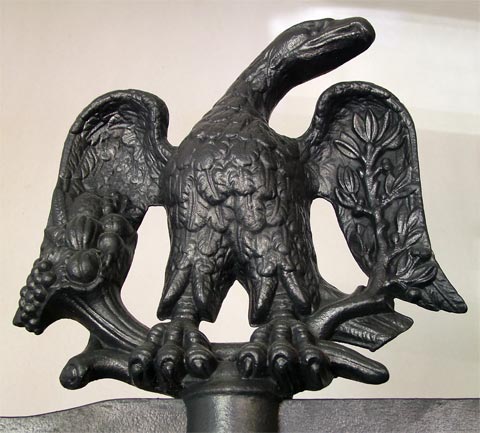
In its talons the eagle clutches a flight of Jove’s thunderbolts, representing war, and the olive branch of peace and the cornucopia or Horn of Plenty, signifying prosperity.
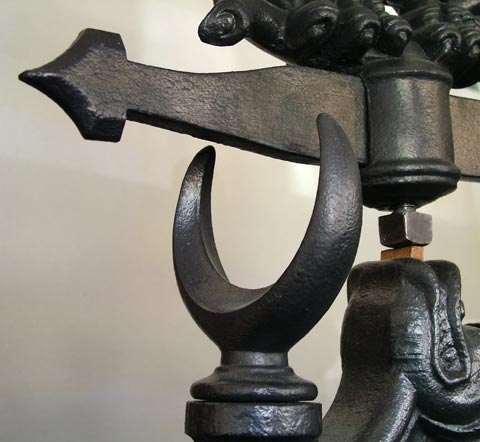
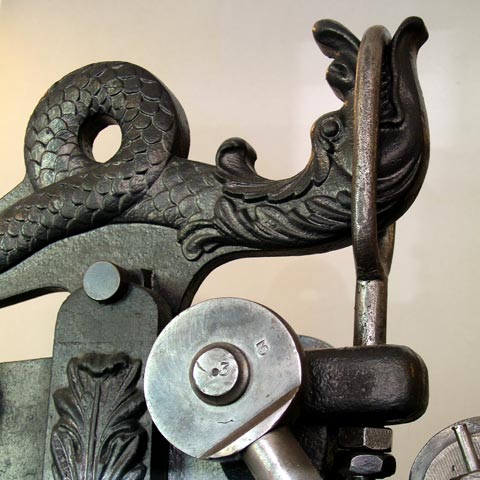
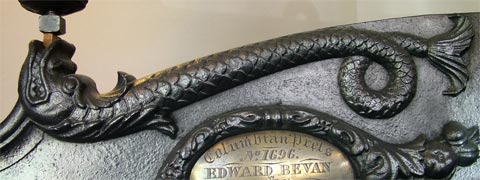
A similar alliance between utility and ornamentation pervades the whole Press. The main counterbalance lever becomes at one end an arrow which rests in the horns of the crescent moon; at the other end it is coiled into the form of a dolphin whose open jaws conveniently hold the hook of the bridle connecting it with the upper end of the great lever. Another heraldic dolphin (or similar sea creature) is extended along the upper front of the great lever.
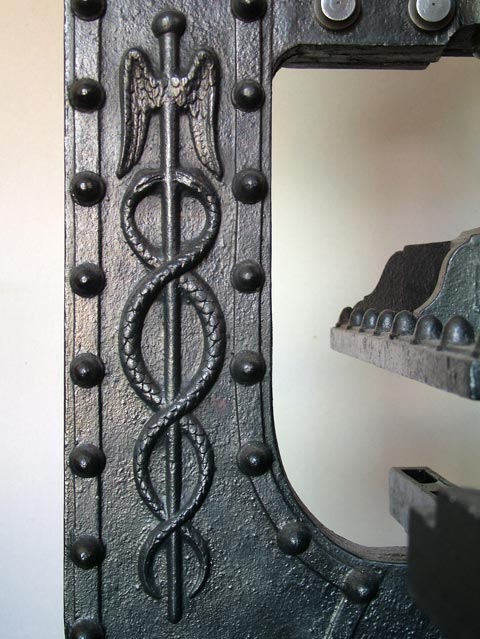
The two pillars of the staple are embellished with the caduceus, the winged staff and intertwined serpents of Hermes. The right-hand pillar also bears near the top a conventional ear of wheat.
Around the nameplate on the face of the great lever on the original Columbian Clymer twined a rattlesnake, the emblem of the original thirteen colonies. After his migration to England he replaced this with a more elaborate but purely decorative design.
 In contrast with the Stanhope Press, the staple of which was merely bolted to a solid base, the Columbian stands on four iron legs terminating in moulded feet which can be accepted as the paws of a lion or the talons of an eagle, according to the taste of the observer.
In the United Kingdom most of the embellishments were retained – the New South Wales Government Printing Office Columbian, built in London in 1849, has them all except the rattlesnake – but some manufacturers substituted a globe or a lion standing on a laurel wreath for the eagle. On the Continent, the makers took more liberties with the design. Some German shops turned the eagle into a Prussian eagle. French variations included the lion and laurel wreath or globe as a counterbalance weight; a great lever embellished with a figure representing La Belle France and pillars with an obelisk motif instead of the caduceus. Others dispensed almost entirely with decoration, probably with the intention of modernising the appearance of the machine for which they were unable to devise any mechanical improvements.”